



In Saudi Arabia, cooling is not a seasonal load — it is the load. Over a building’s life, the energy spent keeping interiors comfortable will dwarf almost every other operational cost. That makes the building envelope one of the highest-leverage decisions in the whole design, and it is usually settled early, quietly, and without much scrutiny.
What a sandwich panel actually is
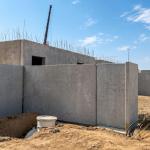
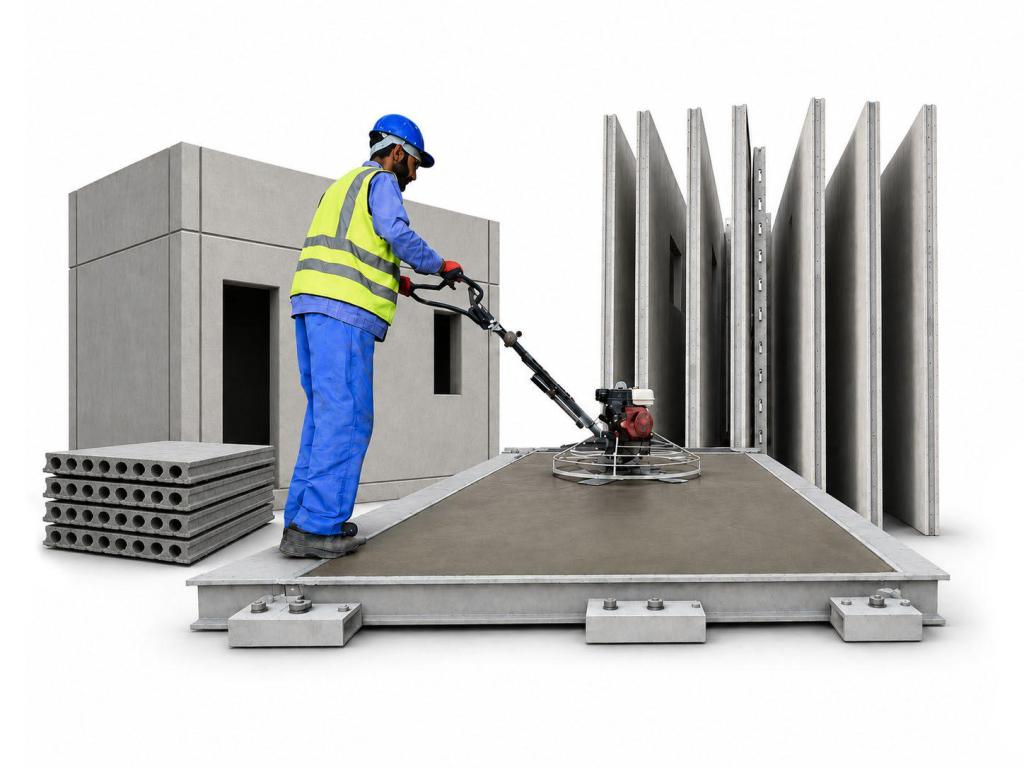
An insulated sandwich panel is a single precast element made of three layers cast together: a structural concrete wythe, a continuous insulation layer, and an outer concrete wythe, tied together with low-conductivity connectors.
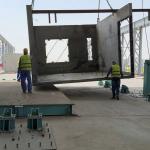
The critical word is together. The insulation is not fixed to the wall after the wall exists. It is placed in the mould and the concrete is cast around it, so the finished element leaves the factory already insulated, already finished on both faces, and ready to erect.
The problem it solves: thermal bridging
Applied insulation systems are only as good as their continuity. Every fixing, every junction, every gap where a board was cut slightly short becomes a thermal bridge — a path where heat crosses the envelope regardless of how well-specified the insulation was.
On site, in heat, at pace, perfect continuity is difficult. Boards get trimmed to fit. Junctions at slab edges and around openings get improvised. The specification says one thing; the built envelope performs like another.
Casting the insulation inside the panel changes the economics of that risk. Continuity is established in a mould, under supervision, in a repeatable process — not on a scaffold in August.
Where it matters most
- Slab edges, traditionally one of the worst bridges in a conventional build
- Window and door reveals, where applied systems are hardest to keep continuous
- Corners and junctions, where two planes of insulation must meet cleanly
Thermal mass, working with you rather than against you
There is a second effect worth understanding. In a hot, dry climate with a significant day-night temperature swing, concrete’s thermal mass is an asset — but only if it is on the right side of the insulation.
In a sandwich panel, the inner structural wythe sits inside the insulation layer, thermally coupled to the interior. It absorbs heat during the day and releases it slowly, damping internal temperature swings and shifting peak cooling demand away from the hottest part of the afternoon.
Put the mass outside the insulation and you get the opposite: a wall that soaks up solar gain all day and radiates it inward through the evening.
The durability argument
Beyond energy, there is a maintenance case. Applied external insulation and render systems have a service life and a failure mode: they crack, they delaminate, they need inspection and periodic repair, and in a UV- and dust-heavy environment they age quickly.
A sandwich panel’s outer wythe is concrete. It is the same material as the structure, it ages at the same rate, and it does not require a maintenance regime of its own. The insulation is protected from UV, moisture and physical damage for the life of the building because it is entombed in concrete.
What to watch for
Sandwich panels are not automatically better — they are better when detailed properly. Three things determine whether you get the performance you specified:
- Connector selection. The ties that hold the two wythes together cross the insulation layer. Steel connectors conduct heat; low-conductivity composite connectors substantially reduce that loss. This is a specification decision with real performance consequences.
- Panel joint detailing. The insulation must remain continuous across the joint between adjacent panels, or you have simply relocated the bridge.
- Insulation thickness matched to orientation. A west-facing elevation does not have the same problem as a north-facing one, and a single specification across all four elevations is usually either over- or under-designed somewhere.
The long view
Envelope decisions are effectively permanent. You can replace chillers, upgrade controls and re-lamp a building, but almost nobody re-clads a structure to fix a thermal performance problem discovered in year three.
That asymmetry is the argument for getting the wall right at the outset — and for preferring a system where the performance is manufactured in rather than applied on.
