



Precast can look like a black box from the client side: drawings go in, finished elements arrive on a truck. In reality every panel and every module passes through the same ten stages, and knowing what happens at each explains both why precast programmes are predictable and where they actually go wrong.
1. Engineering and shop drawings
Before anything is cast, the architectural and structural intent is translated into manufacturing information: element schedules, reinforcement details, connection design, lifting points and tolerances. This is also where value engineering happens — rationalising element types, maximising repetition, and resolving buildability issues while they are still free to fix.
Where it goes wrong: approvals. Shop drawings that sit unreviewed are the most common cause of production delay, and the time is never recovered later.
2. Mould preparation
Steel moulds are set to the approved geometry, cleaned and treated. Mould setting is a precision activity — dimensional accuracy in the finished element is inherited directly from here.
This stage is why repetition matters commercially. One mould producing many identical units is efficient; many moulds each producing one unit is not.
3. Reinforcement and cast-in items
Reinforcement cages are placed, along with everything that must be embedded: lifting anchors, connection plates, electrical conduits, sleeves and fixings.
Where it goes wrong: late MEP coordination. A conduit that was not in the drawing at this stage becomes a chased channel cut into a finished panel — slow, ugly and avoidable.
4. Insulation placement (insulated panels)
For sandwich panels, the insulation layer and its low-conductivity connectors are positioned between wythes. Continuity here determines the thermal performance the building will have for its entire life.
5. Casting
Concrete is batched to a controlled mix, placed and compacted. Because this happens in a plant rather than on a scaffold, mix consistency, compaction and placement conditions are controlled rather than negotiated with the weather.
6. Curing
Elements cure under controlled conditions until they reach the strength required for handling. This is the stage that cannot be compressed by pressure — only by planning. Attempting to shorten it is the single most damaging thing anyone can do to a precast element.
7. Demoulding and finishing
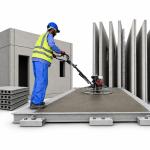
Units are lifted from the mould and finished: surface treatment, edge preparation and any architectural finish. The element is inspected against its drawing and dimensional tolerances are verified.
8. QA/QC and storage
Each element passes defined hold points before it is released. Cube tests, dimensional checks, cover verification and visual inspection are recorded against the individual unit, so every element on the building is traceable.
Released units move to the stockyard, stacked and supported correctly — poor stacking damages more elements than transport does.
9. Loading and delivery
Loads are made up in erection order, not production order, and dispatched against confirmed site readiness. Sequencing here is what separates a smooth erection from a site full of double-handled panels.
Where it goes wrong: dispatching before verifying that foundations, access and crane availability are actually ready.
10. Erection, grouting and final finishing
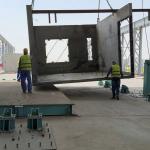
Units are lifted, positioned, aligned and temporarily propped, then connections are grouted and joints sealed. Supervised placement matters — alignment errors compound along a run and are far cheaper to prevent than to correct.
What the sequence tells you
Two patterns emerge from looking at the process as a whole.
First, almost every failure is an information failure, not a concrete failure. Late approvals, late MEP coordination, unverified foundations, changed sequences. The concrete does what concrete does; the schedule breaks where information arrives after the stage that needed it.
Second, the leverage is all at the front. Decisions made at stage one — repetition, module dimensions, connection strategy — determine the cost and duration of the other nine. This is why bringing precast into the conversation at concept stage returns so much more than introducing it at tender.
