


Developers comparing quotes for the first time are often surprised how differently modular contractors price and structure their scope compared with a conventional builder. Understanding what separates modular construction companies in Saudi Arabia from traditional contractors — and from each other — makes that comparison far easier, and it usually changes which option actually comes out ahead for a given project.
What Modular Construction Companies in Saudi Arabia Actually Offer
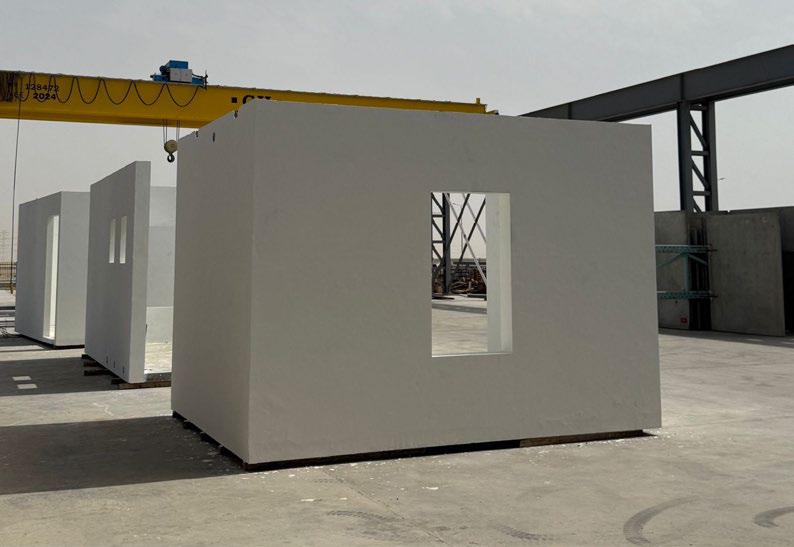
Not all “modular” contractors offer the same thing. Some produce flat 2D precast panels assembled on site. A smaller group produce true 3D monolithic modules — complete room volumes cast as one unit with no cold joints, then lifted directly into place. The distinction matters because it changes both the programme benefit and the type of project each system suits.
3D Modular vs Traditional Construction: The Core Differences
The comparison usually comes down to three things developers actually care about: how fast the project finishes, how consistent the quality is, and what the total cost looks like once every line item is counted.
Programme and Speed
Traditional construction sequences trades on site — foundations, then structure, then envelope, then finishes — largely one after another. Modular construction lets factory production run in parallel with site groundworks, which is the single biggest reason modular projects finish faster, particularly on developments with repeating unit types like villas or staff housing.
Quality and Consistency
A module cast under controlled factory conditions is dimensionally consistent from the first unit to the last. Site-poured concrete depends heavily on weather, labour consistency and inspection timing, which is why defect rates and finish quality tend to vary more on traditional builds, especially across a large number of repeated units.
Cost Structure
Traditional construction costs scale roughly linearly with scope. Modular costs are front-loaded — engineering and mould costs are highest on the first unit and drop sharply as repetition increases — so modular tends to win decisively on high-repetition projects and less decisively, or not at all, on one-off or highly bespoke buildings.
How to Evaluate Modular Construction Companies in Saudi Arabia
Look past the marketing language and check for three things: an in-house engineering team producing their own shop drawings, a factory they own and can show you, and a completed project portfolio that matches your building type and scale. Certifications — ISO 9001 for quality, ISO 45001 for safety, ISO 14001 for environmental management — are a fast way to confirm the internal systems behind the marketing actually exist.
When Traditional Construction Still Makes Sense
Modular is not universally the better answer. Highly bespoke, architecturally irregular buildings with few or no repeated units rarely justify the upfront engineering and mould investment that makes modular economics work. For those projects, 2D precast for structural elements combined with conventional construction for irregular portions is often the more cost-effective route.
Hybrid Approaches: Combining 2D Precast and 3D Modular
Many Saudi developments do not fit neatly into one category — a villa compound might use 3D monolithic modules for repeated house types alongside 2D precast boundary walls, hollow core slabs for a shared amenity building, and cast-in-place foundations throughout. Modular construction companies in Saudi Arabia that offer both 2D and 3D systems under one contract can mix methods by what each part of the project actually needs, rather than forcing a single method across a mixed-use scope.
Questions to Ask Before Signing With Any Modular Contractor
A short, direct set of questions during the tender stage separates the modular construction companies in Saudi Arabia with real delivery capability from those still building it out.
Who Actually Owns the Production Line?
Ask whether the moulds, casting beds and factory are owned by the company bidding for your project, or subcontracted from a third party. Owned capacity means your project has a guaranteed slot; subcontracted capacity means you are competing with someone else’s schedule for the same equipment.
What Happens If the Design Changes Mid-Production?
Design changes are common on real projects. A contractor with in-house engineering can usually absorb a reasonable change quickly; one relying on an external design consultant often cannot, and the delay compounds every time a revision is needed.
How Regional Location Affects Which Company to Choose
A modular contractor’s factory location matters more than it might first appear, because transport cost and delivery reliability scale directly with distance from factory to site.
Matching Factory Location to Project Location
A Jeddah-based project naturally favours a Jeddah-based factory; a large, long-duration Riyadh or Eastern Province programme may justify a supplier’s mobile production option instead. Ask any shortlisted company directly how they plan to serve your specific region before comparing prices, since two otherwise similar quotes can carry very different real-world delivery risk.
Frequently Asked Questions About Modular Construction Companies in Saudi Arabia
Are All Modular Construction Companies in Saudi Arabia Offering the Same System?
No. Some offer only 2D panelised precast, others offer true 3D monolithic modules, and a few offer both alongside conventional civil works — the underlying technology and scope of in-house control varies considerably between companies marketed under the same “modular” label.
How Long Has Modular Construction Been Used in Saudi Arabia?
Precast and modular methods have been used in the Kingdom for decades in various forms, but adoption has accelerated significantly in recent years as Vision 2030’s construction pipeline has pushed developers toward faster, more predictable delivery methods.
Can a Modular Contractor Also Handle Traditional Scope on the Same Project?
Many can, particularly civil works, foundations and site infrastructure. Using one contractor for both modular and conventional scope on a mixed project reduces the coordination risk of managing two separate contracts with two separate programmes.
Choosing Among Modular Construction Companies in Saudi Arabia
The right choice depends less on which company markets modular construction loudest and more on which one can show in-house engineering, owned production capacity, verified certifications and completed work at your project’s scale. SHB runs both 3D monolithic modular and 2D precast production from a single ISO-certified facility in Jeddah, so the same team can help decide which method — or mix of methods — fits your development. Explore SHB’s modular and precast systems or share your drawings for a comparison against traditional construction.
