



Most developers do not need to be convinced precast exists — they need a clear-eyed comparison to decide whether it is right for their specific project. Precast vs traditional construction Saudi Arabia developers weigh up usually comes down to four practical questions: which costs less, which finishes faster, which delivers better quality, and which offers more design freedom. None of these questions has a single right answer that applies to every project — the correct comparison always depends on the specific scope, repetition and timeline in front of the developer making the decision, which is exactly what this comparison is designed to help work through.
Precast vs Traditional Construction Saudi Arabia Developers Are Weighing Up
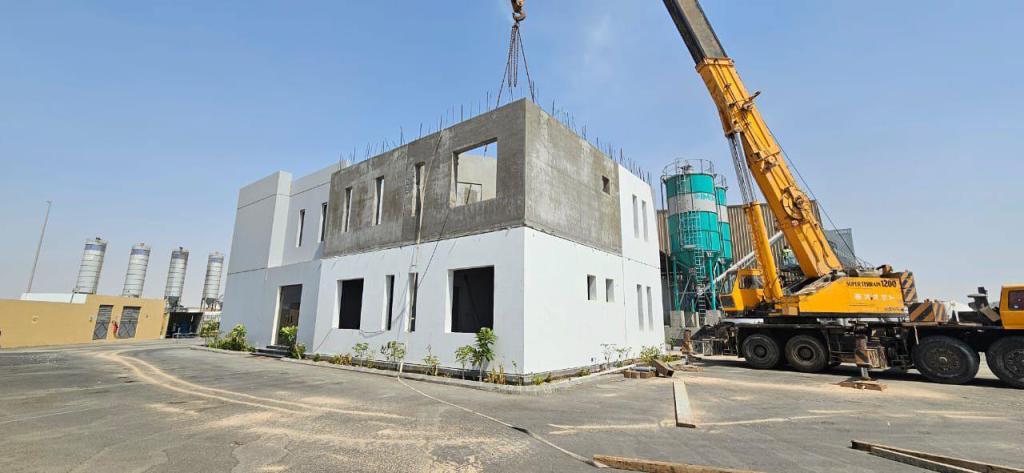
Traditional cast-in-place construction builds a structure trade by trade, on site, largely in sequence. Precast manufactures structural and enclosure elements in a factory and assembles them on site, allowing production and site preparation to happen simultaneously. That single structural difference — sequential versus parallel workflow — is the root cause of almost every other difference between the two methods.
Cost Comparison
Traditional construction costs scale close to linearly with scope, with labour representing a large and somewhat unpredictable share of the total. Precast front-loads cost into engineering and mould production, which then amortises across repeated units — meaning precast tends to win clearly on repetitive projects and loses some or all of its advantage on one-off, highly bespoke structures. A fair comparison always needs to weigh total delivered cost, including financing carried over the construction period, not just a per-square-metre material price. Developers who compare only the material or panel price, without accounting for programme duration and its financing cost, routinely reach the wrong conclusion about which method actually saves money on their specific project.
Speed Comparison
Speed is where precast’s advantage is most consistent and most visible across project types.
Parallel Production vs Sequential Site Work
While a precast factory is casting wall panels, floor slabs or modules, the site team can be preparing foundations and utilities at the same time — work that on a traditional project would happen one after another. For repetitive developments like villa compounds, this parallel approach is consistently what compresses total programme duration, rather than any single construction stage being dramatically faster.
Quality Comparison
Quality consistency is the other area where the gap between methods tends to be largest and most consistent.
Factory Tolerance vs Site Variability
A precast element cast in controlled factory conditions — consistent formwork, controlled curing, quality checks before it leaves the yard — is dimensionally consistent from the first unit to the thousandth. Site-poured concrete is exposed to weather, inconsistent curing conditions and variable labour quality, all of which introduce defect risk that tends to grow, not shrink, as project scale increases.
Design Flexibility: Where Traditional Construction Still Wins
Traditional construction retains a genuine advantage for highly bespoke, architecturally irregular buildings with few or no repeated elements, since precast’s cost and programme benefits depend on standardisation that a one-off design cannot always provide. For these projects, the honest comparison often favours traditional construction, or a hybrid approach using precast selectively for structural elements while finishing the rest conventionally. A single architecturally striking landmark building, for instance, is rarely a good candidate for full modular conversion, even though its foundations, internal partitions or a repeated wing might still benefit from precast methods applied selectively.
Safety and Site Impact
Moving production off site reduces the number of workers and trades active on a live construction site at any given time, which lowers exposure to site-specific safety risk and reduces disruption — noise, dust, traffic — to surrounding areas, a consideration that matters increasingly on urban infill sites in dense parts of Jeddah, Riyadh and Dammam. Fewer active trades on site also means simpler supervision and a cleaner audit trail for safety compliance, both of which are increasingly expected on projects tied to institutional or government clients.
Environmental Impact: Another Point of Comparison
Sustainability is increasingly part of how developers weigh precast vs traditional construction Saudi Arabia projects, not just cost and speed.
Material Efficiency and Waste
Factory production allows tighter control over material quantities and formwork reuse than a site-cast operation typically achieves, generally producing less construction waste per unit of building delivered. Off-cuts and rejected elements in a factory setting are also easier to recycle back into the production process than scattered site waste.
Reduced Site Disruption
Fewer trucks, less on-site mixing and a shorter overall site duration reduce dust, noise and local traffic disruption compared with a traditional build running for a longer period — a genuine benefit on projects near residential neighbourhoods or sensitive areas.
Frequently Asked Questions About Precast vs Traditional Construction Saudi Arabia
Which Wins on Precast vs Traditional Construction Saudi Arabia for a Single Villa?
For a single, highly customised villa, traditional construction often remains competitive or preferable, since precast’s cost advantage depends on repetition that a one-off project cannot provide.
Can Precast and Traditional Methods Be Combined on One Project?
Yes, hybrid approaches are common — using precast for repetitive structural elements like floors and boundary walls while finishing bespoke or irregular portions of a building conventionally is a practical middle ground many developers choose.
Does Precast Construction Require Different Contractors Than Traditional Construction?
Not entirely — civil works, foundations and site infrastructure are similar across both methods, but the structural and enclosure work requires a contractor with in-house precast engineering and production capability rather than a conventional building contractor alone.
Which Method Fits Your Project
The honest answer to precast vs traditional construction in Saudi Arabia depends on repetition, design complexity and how much programme certainty the project needs — not a universal rule favouring one method over the other. Every project deserves its own honest assessment rather than a default answer picked in advance. SHB works across both 2D precast, 3D modular and conventional civil scopes from its Jeddah facility, and can advise honestly on which combination suits your specific project. Share your drawings with SHB for a cost and programme comparison before you commit to a method.
